

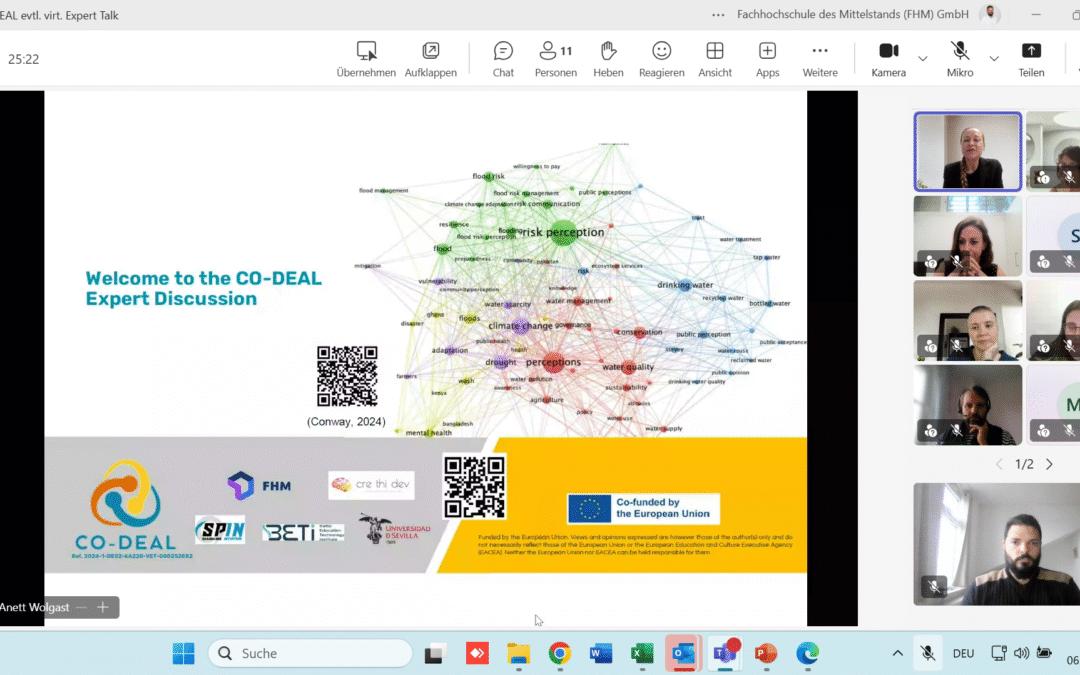
European experts and municipal representatives shared innovative ideas and practical strategies to strengthen community resilience in the face of climate change.
The CO-DEAL Expert Discussion, held virtually on 6 October 2025, convened European experts, municipal representatives, and project partners to exchange insights on climate-related challenges and resilience strategies. Moderated by Prof. Dr. Anett Wolgast and Tomas Lengemann, the event featured three keynote presentations followed by a moderated discussion.
Dr Jürgen Laudien (German Life Saving Association, DLRG) addressed the increasing complexity of water safety due to climate change. He highlighted the need for extended lifeguard operations, the use of drones for flood mapping and logistics, and the importance of emotional regulation and rapid decision-making in crisis leadership. His four-step strategy—assess, prioritise, communicate, and act—was illustrated through the 2023–24 Christmas flood response, where swift coordination helped protect a village from flooding.
Dr Iuliia Polkova (German Weather Service, DWD) presented on climate prediction tools. She explained the difference between short-term weather forecasts and long-term climate projections, emphasising the rising frequency and intensity of extreme events. DDWD’s services include sub-seasonal to decadal climate forecasts, a hazard portal, and tailored warnings for various types of extreme events. She stressed the importance of regular public training to ensure preparedness becomes instinctive.
Dr Ralf Schüle (Federal Office for Building and Regional Planning) explored the role of digital tools in urban resilience. He outlined Germany’s Smart City funding programme and emphasised the need for cross-sectoral cooperation, data competence, and organisational transformation. He argued that digital infrastructure alone is insufficient without strategic integration and skilled personnel.
The discussion concluded with reflections on participatory processes, particularly the inclusion of vulnerable groups. Experts agreed that training, emotional preparedness, and digital literacy are essential pillars of climate resilience. The event highlighted the importance of interdisciplinary collaboration to build adaptive and inclusive communities.